

Back
Asbestos is not just a construction problem: the risk also affects transport workers
Asbestos is not just a construction problem: the risk also affects transport workers
Asbestos is not just a construction problem: the risk also affects transport workers
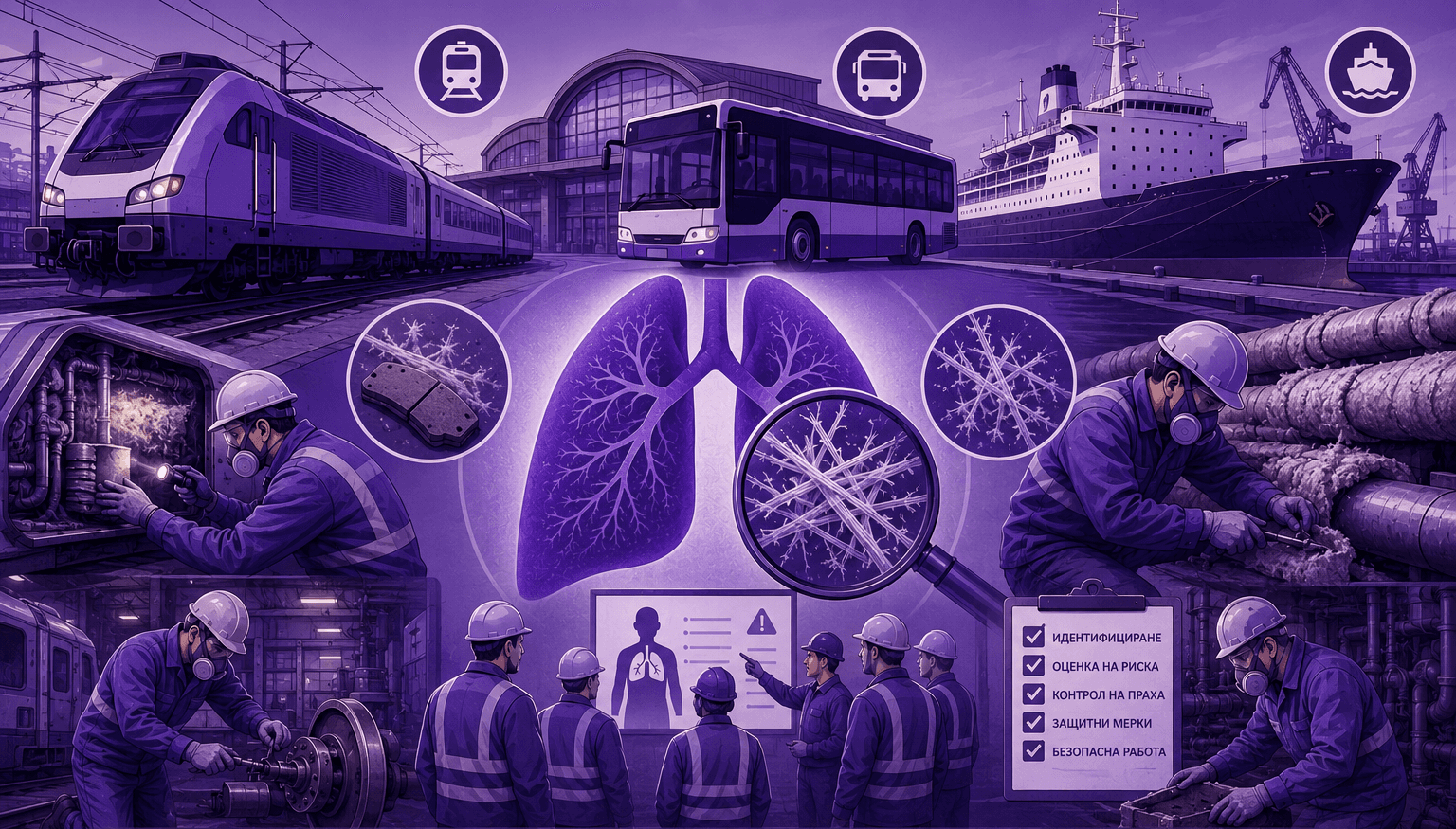
The European theme of asbestos-related occupational diseases has direct relevance for the transport sector as well.
Asbestos is often associated primarily with construction, old buildings, and renovation works. But this dangerous carcinogen has a much broader occupational scope. It also affects transport workers — especially those who carry out maintenance, repair, dismantling, modernization, or servicing of old transport equipment, depots, repair bases, ports, ships, railway facilities, and transport infrastructure buildings.
In a European Commission draft document "Updating Recommendation 2003/670/EC concerning the European schedule of occupational diseases as regards asbestos-related diseases," dedicated to updating the list of asbestos-related occupational diseases, it is emphasized that asbestos is a major occupational carcinogen for which there is no safe level of exposure. The document also points out that, despite the ban on the use of asbestos in the EU since 2005, it continues to be found in many old buildings and materials, and the diseases caused by it can manifest decades after exposure.
This means that the topic is not a thing of the past. It is a matter of current worker protection, prevention, early detection of diseases, and fair recognition and compensation of victims.
Why does asbestos affect transport?
For decades, asbestos was used because of its fire-resistant, heat-insulating, and mechanical properties. That is precisely why it found application in sectors with high temperatures, friction, vibrations, heavy machinery, and a need for insulation — characteristics typical of transport.
In the transport sector, asbestos may have been present or may still be found in:
brake systems and clutches of older vehicles;
railway carriages, locomotives, trams, and repair depots;
insulation around engines, boilers, pipes, cables, and heating systems;
ships, engine rooms, marine piping, and fire-resistant insulation;
old bus, railway, port, and aviation repair bases;
buildings of stations, depots, workshops, halls, and warehouses;
dismantling, scrapping, modernization, and renovation activities.
It is important to clarify that the risk is not the same for all transport workers. The highest risk is for those working in maintenance, repair, dismantling, cleaning after repair activities, recycling, shipbuilding, railway workshops, auto repair shops, and units working with old materials or old equipment. For drivers, engine drivers, crews, and other workers, risk can arise when working in old premises, during accidents, during repair activities, or during contact with contaminated materials.
What diseases are associated with asbestos exposure?
The World Health Organization states that all forms of asbestos are carcinogenic to humans. Exposure to asbestos causes lung cancer, laryngeal cancer, ovarian cancer, and mesothelioma, as well as chronic respiratory diseases such as asbestosis. The WHO also points out that occupational exposure to asbestos causes over 200,000 deaths annually worldwide.
Asbestos-related occupational diseases include:
asbestosis;
mesothelioma;
lung cancer;
laryngeal cancer;
ovarian cancer;
pleural plaques with impaired lung function;
non-malignant pleural effusion;
fibrous diseases of the pleura;
other lung and pleural impairments.
Particularly worrying is the long latent period. Diseases can manifest 20, 30, or more years after exposure. The European Commission explicitly notes that the first signs of disease can appear 30 years or more after the time of exposure, meaning that diseases resulting from past exposure will continue to manifest in the coming years.
The European framework is being updated — this is also important for transport workers
In 2025, the European Commission updated the European schedule of occupational diseases. In it, laryngeal cancer, ovarian cancer, pleural plaques with functional lung impairment, and non-malignant pleural effusion have been added as diseases caused by asbestos. The additional list also includes colorectal cancer, rectal cancer, and stomach cancer related to asbestos.
This development is of direct relevance to transport workers because occupational risk does not depend on the sector's label, but on real exposure to the hazardous substance. If a transport worker was exposed to asbestos during repair, maintenance, dismantling, work in a depot, ship, workshop, port, or old infrastructure, their disease should be viewed through the prism of occupational exposure.
The EU has also taken stricter measures to limit exposure. Directive (EU) 2023/2668 introduced a significantly lower exposure limit value for asbestos — 0.01 fibers per cubic centimeter as an eight-hour time-weighted average until 21 December 2029, and from 21 December 2029, even more precise measurement and control requirements are envisaged.
Rail, road, and maritime transport: examples of real risk!
The railway sector, including subways, is one example where the link between asbestos and occupational risk is well documented. For decades, asbestos was used in locomotives, carriages, subway trains, brake systems, insulations, tunnel infrastructure, and repair bases. Particularly at risk are workers in maintenance, repair, and modernization of old transport equipment and rolling stock. A study among railway carriage maintenance workers in Bologna, Italy, tracked a group of 2,197 men exposed to asbestos between 1960 and 1979. The study found a significant burden of asbestos-related diseases, including pleural cancer, with the risk increasing with time from the start of exposure. Similar risks have been identified among subway workers. International studies show that during the repair and modernization of older subway stations and underground infrastructure, asbestos materials and asbestos fibers in the air can be found. Particularly at risk are workers in maintenance, repair, electrical installations, ventilation systems, and infrastructure activities in enclosed underground spaces.
Maritime transport and shipbuilding are also among the historically most affected areas. In ships, asbestos was used for insulation of hulls, engine rooms, piping, air conditioning systems, walls, and fire barriers. A study among shipyard workers in Monfalcone, Italy, established a strong link between the accumulated amount of asbestos fibers in the lungs and the risk of mesothelioma.
In road and bus transport, the risk is particularly relevant for mechanics and workers who service brakes and clutches. The US Environmental Protection Agency warns that brake and clutch repair and replacement can release asbestos dust when these components contain asbestos, and workers cannot detect its presence by appearance alone.
What needs to be done?
From the perspective of FTTU, the topic of asbestos must be part of the broader policy for safe and healthy working conditions in transport. An active approach is needed, encompassing prevention, control, training, medical surveillance, and protection of workers' rights.
First, employers must identify potential asbestos-containing materials in transport infrastructure, rolling stock, ships, workshops, depots, halls, and repair bases. Before any repair, reconstruction, dismantling, or modernization, there must be a clear risk assessment.
Second, workers must be informed and trained. No one should be sent to work with unfamiliar old insulation, dusty materials, brake systems, piping, or panels without prior inspection, instructions, and protective measures.
Third, the practice of dry cleaning, blowing with compressed air, or mechanical disruption of suspicious materials without a controlled procedure must be prohibited. If asbestos is suspected, work should only be carried out using specialized methods, appropriate equipment, filtration, dust containment, and personal protective equipment.
Fourth, documentation of potential exposure must be kept. This is important not only for current safety but also for future medical follow-up and eventual recognition of an occupational disease.
Fifth, the state, employers, and social partners must work for better recognition of asbestos-related diseases. The European Recommendation highlights the role of Member States, social partners, health systems, and institutions in prevention, diagnosis, statistics, and recognition of occupational diseases.
The position of FTTU: prevention, recognition, and protection!
Asbestos is not just a construction problem. It is also a transport problem when it affects the people who maintain, repair, modernize, and service the transport system. Therefore, the topic must be placed clearly on the sector's agenda.
FTTU insists on higher awareness, better prevention, and real protection of transport workers. Where there is a risk of asbestos exposure, there must be control, training, protective measures, and medical surveillance. Where a disease is already present, there must be fair recognition, support, and compensation.
Transport workers and their health cannot be put at risk by dangerous materials left over from the past. Asbestos may be banned, but its consequences are still alive. That is precisely why the response must be active, timely, and fair.
Asbestos is not the past. For many workers, it is a current risk and a future diagnosis. Therefore, prevention today is the strongest protection tomorrow.
The European theme of asbestos-related occupational diseases has direct relevance for the transport sector as well.
Asbestos is often associated primarily with construction, old buildings, and renovation works. But this dangerous carcinogen has a much broader occupational scope. It also affects transport workers — especially those who carry out maintenance, repair, dismantling, modernization, or servicing of old transport equipment, depots, repair bases, ports, ships, railway facilities, and transport infrastructure buildings.
In a European Commission draft document "Updating Recommendation 2003/670/EC concerning the European schedule of occupational diseases as regards asbestos-related diseases," dedicated to updating the list of asbestos-related occupational diseases, it is emphasized that asbestos is a major occupational carcinogen for which there is no safe level of exposure. The document also points out that, despite the ban on the use of asbestos in the EU since 2005, it continues to be found in many old buildings and materials, and the diseases caused by it can manifest decades after exposure.
This means that the topic is not a thing of the past. It is a matter of current worker protection, prevention, early detection of diseases, and fair recognition and compensation of victims.
Why does asbestos affect transport?
For decades, asbestos was used because of its fire-resistant, heat-insulating, and mechanical properties. That is precisely why it found application in sectors with high temperatures, friction, vibrations, heavy machinery, and a need for insulation — characteristics typical of transport.
In the transport sector, asbestos may have been present or may still be found in:
brake systems and clutches of older vehicles;
railway carriages, locomotives, trams, and repair depots;
insulation around engines, boilers, pipes, cables, and heating systems;
ships, engine rooms, marine piping, and fire-resistant insulation;
old bus, railway, port, and aviation repair bases;
buildings of stations, depots, workshops, halls, and warehouses;
dismantling, scrapping, modernization, and renovation activities.
It is important to clarify that the risk is not the same for all transport workers. The highest risk is for those working in maintenance, repair, dismantling, cleaning after repair activities, recycling, shipbuilding, railway workshops, auto repair shops, and units working with old materials or old equipment. For drivers, engine drivers, crews, and other workers, risk can arise when working in old premises, during accidents, during repair activities, or during contact with contaminated materials.
What diseases are associated with asbestos exposure?
The World Health Organization states that all forms of asbestos are carcinogenic to humans. Exposure to asbestos causes lung cancer, laryngeal cancer, ovarian cancer, and mesothelioma, as well as chronic respiratory diseases such as asbestosis. The WHO also points out that occupational exposure to asbestos causes over 200,000 deaths annually worldwide.
Asbestos-related occupational diseases include:
asbestosis;
mesothelioma;
lung cancer;
laryngeal cancer;
ovarian cancer;
pleural plaques with impaired lung function;
non-malignant pleural effusion;
fibrous diseases of the pleura;
other lung and pleural impairments.
Particularly worrying is the long latent period. Diseases can manifest 20, 30, or more years after exposure. The European Commission explicitly notes that the first signs of disease can appear 30 years or more after the time of exposure, meaning that diseases resulting from past exposure will continue to manifest in the coming years.
The European framework is being updated — this is also important for transport workers
In 2025, the European Commission updated the European schedule of occupational diseases. In it, laryngeal cancer, ovarian cancer, pleural plaques with functional lung impairment, and non-malignant pleural effusion have been added as diseases caused by asbestos. The additional list also includes colorectal cancer, rectal cancer, and stomach cancer related to asbestos.
This development is of direct relevance to transport workers because occupational risk does not depend on the sector's label, but on real exposure to the hazardous substance. If a transport worker was exposed to asbestos during repair, maintenance, dismantling, work in a depot, ship, workshop, port, or old infrastructure, their disease should be viewed through the prism of occupational exposure.
The EU has also taken stricter measures to limit exposure. Directive (EU) 2023/2668 introduced a significantly lower exposure limit value for asbestos — 0.01 fibers per cubic centimeter as an eight-hour time-weighted average until 21 December 2029, and from 21 December 2029, even more precise measurement and control requirements are envisaged.
Rail, road, and maritime transport: examples of real risk!
The railway sector, including subways, is one example where the link between asbestos and occupational risk is well documented. For decades, asbestos was used in locomotives, carriages, subway trains, brake systems, insulations, tunnel infrastructure, and repair bases. Particularly at risk are workers in maintenance, repair, and modernization of old transport equipment and rolling stock. A study among railway carriage maintenance workers in Bologna, Italy, tracked a group of 2,197 men exposed to asbestos between 1960 and 1979. The study found a significant burden of asbestos-related diseases, including pleural cancer, with the risk increasing with time from the start of exposure. Similar risks have been identified among subway workers. International studies show that during the repair and modernization of older subway stations and underground infrastructure, asbestos materials and asbestos fibers in the air can be found. Particularly at risk are workers in maintenance, repair, electrical installations, ventilation systems, and infrastructure activities in enclosed underground spaces.
Maritime transport and shipbuilding are also among the historically most affected areas. In ships, asbestos was used for insulation of hulls, engine rooms, piping, air conditioning systems, walls, and fire barriers. A study among shipyard workers in Monfalcone, Italy, established a strong link between the accumulated amount of asbestos fibers in the lungs and the risk of mesothelioma.
In road and bus transport, the risk is particularly relevant for mechanics and workers who service brakes and clutches. The US Environmental Protection Agency warns that brake and clutch repair and replacement can release asbestos dust when these components contain asbestos, and workers cannot detect its presence by appearance alone.
What needs to be done?
From the perspective of FTTU, the topic of asbestos must be part of the broader policy for safe and healthy working conditions in transport. An active approach is needed, encompassing prevention, control, training, medical surveillance, and protection of workers' rights.
First, employers must identify potential asbestos-containing materials in transport infrastructure, rolling stock, ships, workshops, depots, halls, and repair bases. Before any repair, reconstruction, dismantling, or modernization, there must be a clear risk assessment.
Second, workers must be informed and trained. No one should be sent to work with unfamiliar old insulation, dusty materials, brake systems, piping, or panels without prior inspection, instructions, and protective measures.
Third, the practice of dry cleaning, blowing with compressed air, or mechanical disruption of suspicious materials without a controlled procedure must be prohibited. If asbestos is suspected, work should only be carried out using specialized methods, appropriate equipment, filtration, dust containment, and personal protective equipment.
Fourth, documentation of potential exposure must be kept. This is important not only for current safety but also for future medical follow-up and eventual recognition of an occupational disease.
Fifth, the state, employers, and social partners must work for better recognition of asbestos-related diseases. The European Recommendation highlights the role of Member States, social partners, health systems, and institutions in prevention, diagnosis, statistics, and recognition of occupational diseases.
The position of FTTU: prevention, recognition, and protection!
Asbestos is not just a construction problem. It is also a transport problem when it affects the people who maintain, repair, modernize, and service the transport system. Therefore, the topic must be placed clearly on the sector's agenda.
FTTU insists on higher awareness, better prevention, and real protection of transport workers. Where there is a risk of asbestos exposure, there must be control, training, protective measures, and medical surveillance. Where a disease is already present, there must be fair recognition, support, and compensation.
Transport workers and their health cannot be put at risk by dangerous materials left over from the past. Asbestos may be banned, but its consequences are still alive. That is precisely why the response must be active, timely, and fair.
Asbestos is not the past. For many workers, it is a current risk and a future diagnosis. Therefore, prevention today is the strongest protection tomorrow.

Justice • Solidarity • Development


QUICK LINKS
Accessibility
Terms of Use
Permissible use
Mutual Respect Policy
©2025-2026, Federation of Transport and Trade Unions,
All rights reserved.
Justice • Solidarity • Development
QUICK LINKS
Accessibility
Terms of Use
Permissible use
Mutual Respect Policy
©2025-2026, Federation of Transport and Trade Unions,
All rights reserved.
Justice • Solidarity • Development
QUICK LINKS
Accessibility
Terms of Use
Permissible use
Mutual Respect Policy
©2025-2026, Federation of Transport and Trade Unions, All rights reserved.
Justice • Solidarity • Development
QUICK LINKS
Accessibility
Terms of Use
Permissible use
Mutual Respect Policy
©2025-2026, Federation of Transport and Trade Unions, All rights reserved.
Justice • Solidarity • Development
QUICK LINKS
Accessibility
Terms of Use
Permissible use
Mutual Respect Policy
©2025-2026, Federation of Transport and Trade Unions, All rights reserved.